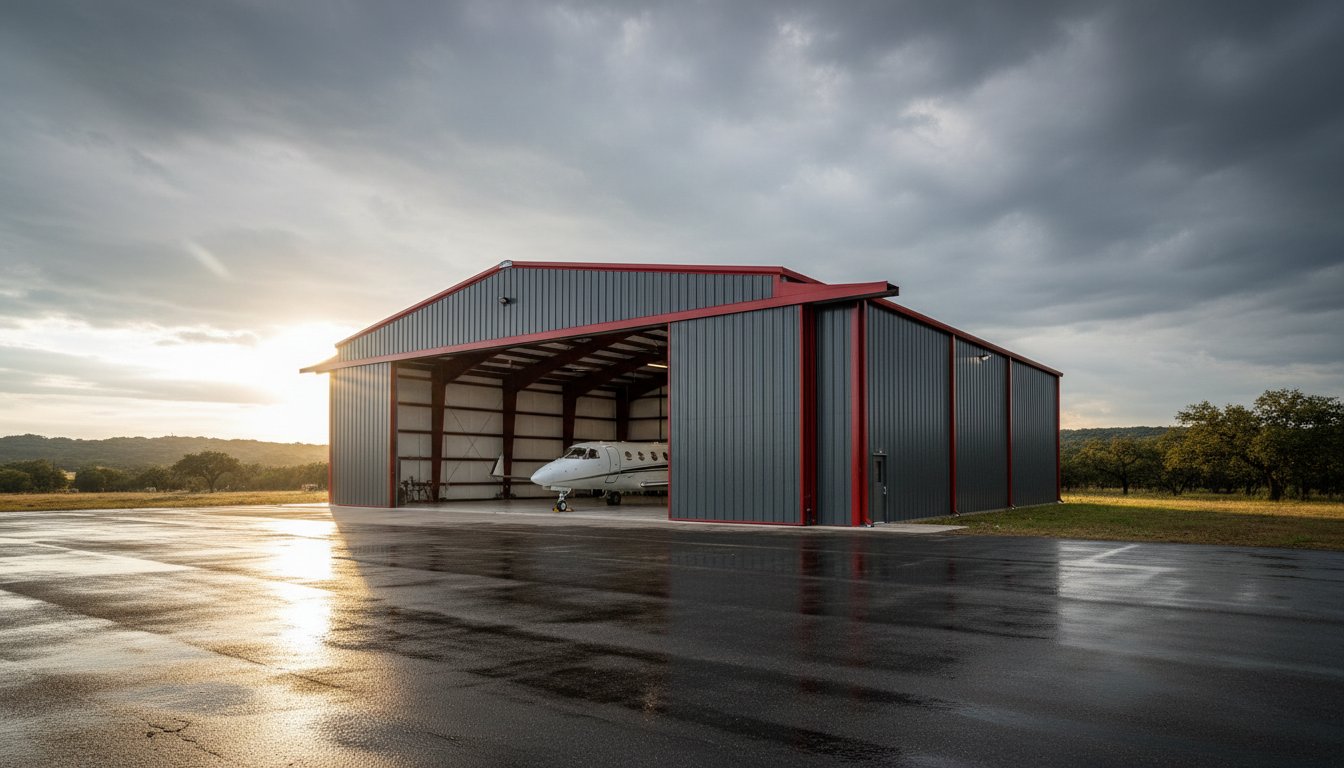
Your aircraft is likely your most expensive asset, yet it probably spends 95 percent of its time sitting on a hot tarmac or in a leased space that costs more than a monthly truck payment. You shouldn’t have to settle for soaring rental fees or worry about 70 mile per hour wind gusts every time a Central Texas storm rolls through. We agree that a pilot deserves a secure, private space where maintenance is easy and the avionics stay dry. Owning your own steel aircraft hangar is the only way to ensure your plane is protected while building real property value on your own terms.
In this guide, you’ll discover how to plan, size, and supply a durable steel structure designed specifically for the unique demands of the Texas landscape. We will walk through the process of selecting a column-free interior for easy maneuvering and choosing materials that withstand the 100 degree heat. You’ll get a clear look at how a straightforward metal building package from Bradberry Steel provides the structural integrity your aircraft requires without the headache of a complicated supply chain.
Key Takeaways
- Understand why red iron steel is the definitive choice for protecting aviation assets against the unique demands of the Texas climate.
- Learn the structural essentials of a high-performance aircraft hangar, focusing on the rigid framing and specialized components that ensure long-term stability.
- Debunk common myths regarding steel and heat by exploring modern insulation systems designed to maintain a comfortable interior environment.
- Gain insights into proper site planning, including how to determine the necessary wingtip clearances and tail heights for your specific storage needs.
- Discover how to utilize 3D design tools to visualize your structure and streamline the supply process for your next project.
What is an Aircraft Hangar and Why is Steel the Texas Standard?
An aircraft hangar is a specialized steel structure built for the storage, maintenance, and protection of aviation assets. It serves as a fortress for your aircraft, shielding it from the volatile elements common in the Southern Plains. In Central Texas, steel has become the undisputed industry standard for these buildings. Unlike wood-frame structures that succumb to rot or moisture, steel provides a rigid, non-combustible shell that remains stable over decades of use. For over 25 years, Bradberry Steel has provided the heavy-duty metal building packages required to meet these demanding local conditions.
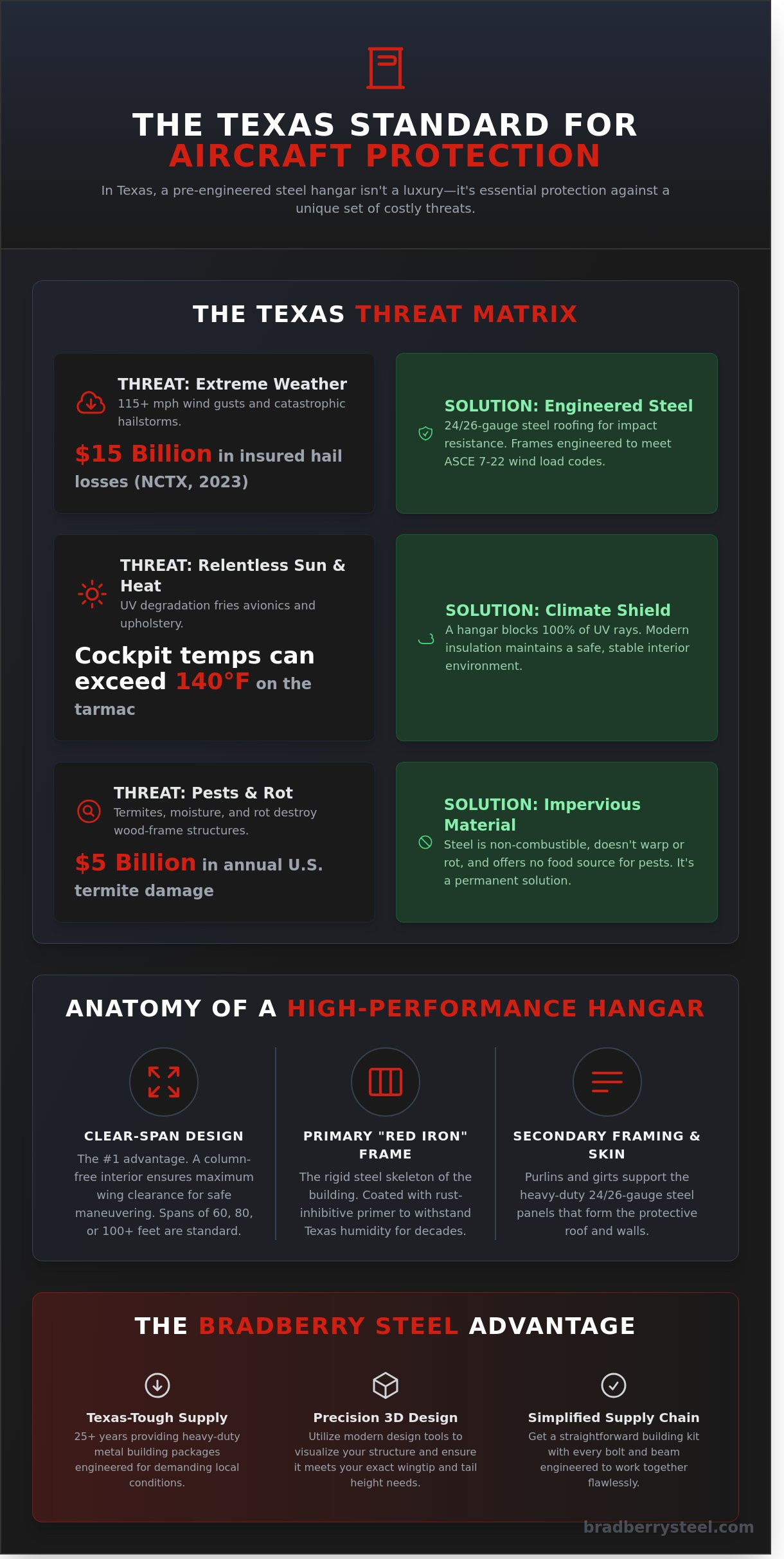
The dominance of steel in the Texas market is a matter of practical survival. Hailstorms in North-Central Texas caused over $15 billion in insured losses in 2023 alone. A standard 26-gauge or 24-gauge steel roof offers a level of impact resistance that shingles or wood cannot match. Beyond the sky, the ground poses its own threats. Termites cause roughly $5 billion in property damage across the United States annually, and they are particularly aggressive in the soft soils of the Brazos Valley. Steel eliminates this risk entirely. It doesn’t warp, it doesn’t burn, and it doesn’t provide a food source for pests.
A dedicated aircraft hangar also acts as a critical climate shield. Texas sun is relentless, often delivering over 2,800 hours of sunshine per year. This constant UV exposure is a silent killer for expensive avionics and leather upholstery. Internal cockpit temperatures can exceed 140 degrees Fahrenheit when a plane sits on a ramp. By moving an aircraft into a steel hangar, owners prevent the UV degradation that cracks windshields and fries sensitive circuit boards. It is a simple calculation: the cost of a steel building kit is a fraction of the cost of replacing a $50,000 Garmin glass cockpit or a full interior refit.
The Importance of Clear-Span Design
Clear-span design refers to a building with a column-free interior. This is the primary reason the industry shifted from wood-frame “pole barns” to red iron steel. Pilots need maximum wing clearance to move aircraft safely. Pre-engineered steel is the only viable option for creating wide-open hangar floors that span 60, 80, or even 100 feet without a single center support post. This unobstructed space is essential for maneuvering light twins like a Beechcraft Baron or larger helicopters like a Bell 407. Without columns in the way, you maximize every square foot of your concrete slab for storage or maintenance work.
Regional Durability: Dublin to Granbury
Building in Erath and Hood counties requires specific attention to wind loads. The open prairies between Dublin and Granbury offer little resistance to 115 mph gusts during spring storm seasons. While some owners consider “weld-up” structures built from scrap pipe, pre-engineered kits are superior because every bolt hole and connection is factory-engineered to meet specific ASCE 7-22 building codes. This precision ensures the building doesn’t just look strong; it is mathematically proven to withstand the pressure. Red iron steel is the backbone of Texas hangar construction. Whether you are expanding a private strip or building at a municipal airport, starting with a 3D design tool at Bradberry Steel ensures your project begins with structural integrity in mind.
Anatomy of a High-Performance Steel Hangar
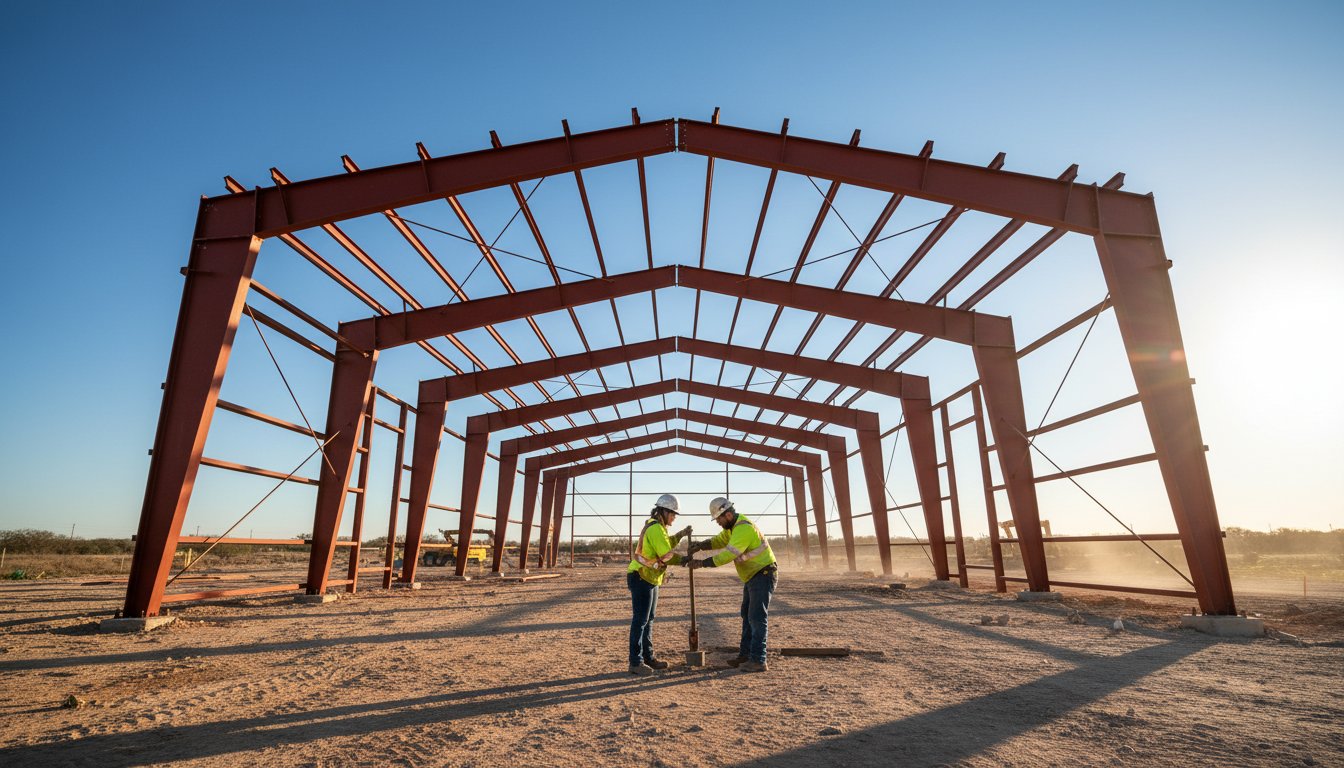
A high-performance aircraft hangar is more than just a large shed. It’s a precision-engineered environment designed to protect a significant investment. The foundation of this protection lies in the primary framing, often called “red iron.” This rigid frame provides the structural skeleton that allows for wide, clear-span interiors. Without interior columns, pilots have the necessary room to move aircraft safely without the risk of ground strikes. This red iron is coated with a rust-inhibitive primer, ensuring the steel stays sound even in the humid shifts of Central Texas seasons.
Secondary framing consists of purlins and girts. These members bridge the gaps between the primary frames, providing the essential support for the exterior metal skin. In the Brazos Valley, wind and weather dictate the strength required for these components. Adhering to NFPA 409 safety standards ensures that the structural design meets specific fire safety and construction benchmarks required for aviation facilities. These standards help guide the spacing and load-bearing requirements for every steel member in the kit.
Roofing systems in Central Texas must withstand extreme conditions. While 26-gauge steel is a common choice for many outbuildings, aircraft owners often opt for 24-gauge standing seam panels. This thicker material provides a critical defense against the 1.5-inch or 2-inch hail that frequently rolls through Dublin and the surrounding areas. A heavier gauge roof reduces the risk of leaks and structural fatigue over decades of service, keeping your cockpit dry and your airframe protected.
Structural Components for Maximum Longevity
Longevity depends on the quality of the secondary steel. Z-purlins and C-purlins are the workhorses of hangar roof support. These cold-formed steel members are shaped to provide maximum stiffness with minimal weight. In a pre-engineered kit, every connection uses high-strength bolts rather than unpredictable field welds. This factory-drilled precision ensures the building remains square and stable for the long haul. Heavy structural steel outlasts light-gauge alternatives by a wide margin. While light-gauge buildings might seem affordable, they often buckle under the 90 mph wind gusts that occur in rural Texas settings. Heavy steel provides a 50-year service life that cheaper materials simply can’t match.
Hangar Door Integration
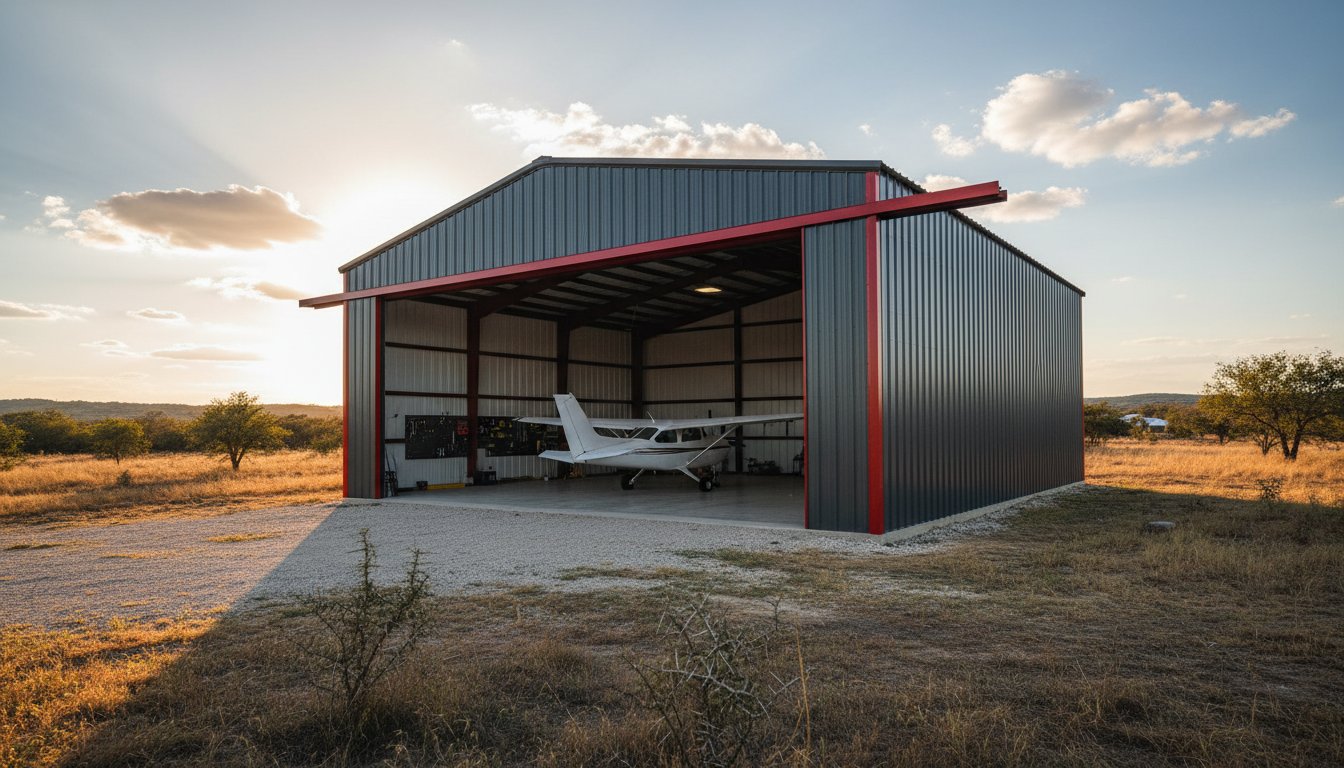
The door is the most critical part of your aircraft hangar design. It’s the only moving wall in the building and the primary point of failure if it isn’t handled correctly. Dublin pilots often choose between hydraulic swing doors and traditional sliding doors. Hydraulic doors offer a clean look and act as a large canopy when open, but they require a massive header to support the weight of the hydraulic rams. Sliding doors are simpler and cost less, but they require bottom tracks that can collect dirt and debris. Your steel frame must be engineered from the start to support these heavy aviation doors. A standard building frame isn’t enough. You need a reinforced header and specialized jambs to ensure the door operates smoothly without warping the building frame. If you’re ready to visualize your layout, you can start your project with our 3D design tool to see how these components fit together.
Steel vs. Heat: Addressing the Insulation Myth
A common misconception in Central Texas is that a steel aircraft hangar acts like an oven during the summer. Folks in Dublin and surrounding counties often worry that metal walls will trap the 100-degree heat and damage their planes. This is a myth that ignores modern engineering. Steel doesn’t have to be a heat trap. In fact, with the right planning, a metal building stays cooler and more comfortable than many traditional wood-frame structures. It all comes down to managing thermal transfer and airflow.
The science behind a cool hangar starts with thermal breaks. These are materials placed between the steel frame and the exterior panels to stop heat from traveling directly into the building. We also utilize “Cool Roof” technology. These specialized metal roof coatings reflect up to 85% of solar radiation back into the atmosphere. Instead of absorbing the sun’s energy, the building sheds it. This keeps the interior temperature manageable even during a brutal Texas July. At Bradberry Steel, we’ve spent over 25 years helping owners select the right components to beat the heat.
Modern Insulation Solutions for Aviation
Insulation is about more than just temperature; it’s about protecting your investment. High-end avionics and leather interiors don’t handle extreme heat or moisture well. You have several reliable options for your aircraft hangar. Fiberglass batts are a cost-effective standard, but spray foam insulation is becoming the preferred choice for many Texas pilots. Spray foam creates an airtight seal that eliminates drafts and prevents pests from nesting in the walls. Radiant barriers are another excellent addition; they use a reflective foil layer to block radiant heat from the sun.
Moisture control is the other half of the battle. When warm, humid air hits a cold metal surface, you get condensation. This “sweating” leads to rust on your airframe and corrosion in your electronics. Proper insulation prevents these temperature swings. When planning your layout, referencing AOPA’s Aircraft Hangar Development Guide helps ensure your design meets industry standards for climate control and storage. A well-insulated steel building can reduce cooling costs by up to 40% compared to uninsulated structures. This stability makes the space much more functional for year-round maintenance work.
Ventilation and Airflow Strategies
Stagnant air is the enemy of a durable building. You need a system that allows the structure to breathe. We recommend using ridge vents at the peak of the roof and louvers on the side walls. This setup creates a natural chimney effect; hot air rises and escapes through the top while pulling cooler air in through the vents below. It’s a simple, low-maintenance way to keep the air moving without increasing your electric bill.
For larger hangar spaces, High-Volume, Low-Speed (HVLS) fans are a game changer. These massive fans move a huge volume of air at a slow pace, creating a perceived cooling effect of 10 degrees for anyone working on the floor. They don’t kick up dust or create the noise of smaller industrial blowers. Combined with a reflective roof and solid insulation, these fans make your hangar a place you actually enjoy spending time in. If you’re ready to see how these features fit into your project, use our 3D design tool to visualize your build. You can also contact Bradberry Steel for a quote on a complete metal building package designed for the Texas climate.
Planning Your Hangar: Sizing and Site Considerations
Planning a project starts with a tape measure and a clear vision. You don’t want to realize your tail fin scrapes the door header after the steel is already bolted down. A standard 40×40 personal aircraft hangar provides enough room for most single-engine planes, but commercial operations in Central Texas often scale up to 100×100 or larger. You need to account for a minimum of 5 feet of wingtip clearance on each side to move the aircraft safely. If you fly a Cessna 182, your 36-foot wingspan will feel cramped in a 40-foot wide opening. Precision at the drafting stage prevents expensive retrofits later.
Bradberry Steel has seen how quickly a pilot’s needs can change over 25 years in the industry. We advise every client to follow the 20% rule. Build your structure 20% larger than your current aircraft requires. This extra square footage isn’t just fluff; it provides essential space for a dedicated workshop, parts storage, or a small pilot lounge. A larger footprint also increases the resale value of the property, as it accommodates a wider variety of airframes for future owners.
Properly outfitting that workshop or storage area often involves sourcing bulk containers for lubricants, cleaning fluids, and other maintenance supplies. For these needs, a specialized supplier like Container Authority can provide the necessary IBC totes, steel drums, and poly drums to keep your hangar organized and your materials safely stored.
Choosing the Right Dimensions
Height is the most overlooked factor in hangar design. While a single-engine Cessna might only need a 12-foot door, moving up to a turboprop or a twin-engine plane often requires 18 feet of clearance or more. Total building height directly impacts your door options, whether you choose a bi-fold, hydraulic, or sliding system. Higher walls require more structural steel, which affects the total project cost. You must balance your current budget with the reality of your future flight goals. Allocating space for a mezzanine or a climate-controlled office inside the perimeter also requires careful vertical planning before the slab is poured.
Site Prep and Local Compliance
The ground under your steel matters as much as the frame itself. Your concrete slab must be engineered to handle specific point loads where the landing gear rests. A standard residential driveway thickness won’t suffice for a heavy twin-engine aircraft. In areas like Brownwood, Weatherford, and Mineral Wells, local soil conditions can vary from rocky plateaus to shifting clay. You must also account for local drainage patterns. Ensuring water flows away from the foundation is the best way to guarantee the longevity of your steel structure over the next 30 years.
Zoning and FAA regulations are critical if your site is near an airport like Stephenville Clark Field (SEP). Federal Aviation Regulation Part 77 defines specific height restrictions for structures near runways. You don’t want to invest in a tall building only to find it violates an approach path. Local building permits in Erath or Parker County also have specific wind load requirements. Our steel packages are designed to meet these rugged Texas standards, ensuring your investment stands up to the straight-line winds and hail common in our region.
Ready to see how your vision fits on your land? Use our 3D tool to design your aircraft hangar and get an accurate quote for your project.
The Bradberry Steel Advantage: Quality Supply for Texas Pilots
Bradberry Steel serves as the foundational partner for Central Texas aviation projects. From our home base in Dublin, we operate as a specialized material supplier for steel projects that demand longevity. We’ve spent 25 years perfecting our role in the supply chain. This experience allows us to provide more than just raw metal; we deliver engineered solutions that withstand the volatile Texas weather. Our team understands that a pilot’s investment is about protecting an asset that requires a controlled, secure environment. We take that responsibility seriously by focusing on the structural integrity of every component we ship.
Visualizing your aircraft hangar shouldn’t require a leap of faith. Our 3D design process allows you to build your structure digitally before the first bolt ever reaches the job site. You can adjust the height for tail clearance, choose door configurations, and select colors that match your existing property. This digital stage ensures that the bill of materials is 100% accurate. When you see the project in three dimensions, you eliminate the common errors found in traditional ordering. It’s a straightforward way to ensure the steel arriving on your trailer is exactly what you planned on your screen.
Buying a complete package from a single Texas source ensures precision that piecemeal ordering cannot match. Every piece of steel is cut, punched, and welded to work in unison. We coordinate the heavy-duty frames with the secondary members and the exterior sheeting so everything aligns during assembly. This level of coordination reduces waste and prevents costly delays. We’re proud to support the local community from our Dublin headquarters, providing the high-quality materials that ranchers and pilots across the Brazos Valley depend on for their daily operations.
Precision Engineering and Design Coordination
Our pre-engineered kits are designed to simplify the construction process for your chosen contractor. We provide the structural skeletons, the wall panels, and the specialized fasteners required for a weather-tight finish. You won’t find yourself hunting for missing trim or mismatched screws. As a family-owned supplier with over two decades of local history, we focus on the details that matter to Texas builders. It’s important to remember that while we provide the complete steel package, the owner is responsible for the concrete slab, the physical labor, and all local permitting. We provide the high-grade materials; you or your contractor provide the site prep and erection.
Getting Started with Your Custom Project
Starting your project is a direct and efficient process. You can use our online tools to define the footprint of your aircraft hangar and customize the aesthetic features. Once your design is finalized, we move into the fabrication phase. We’ll keep you informed as your steel moves through production. When the delivery arrives in Dublin or your specific Central Texas location, you can expect a organized load ready for the next phase of your build. The transition from a digital model to a physical structure is seamless because we prioritize accuracy in our fabrication shop. Start your 3D design today with Bradberry Steel to see how professional-grade supply can transform your property.
Secure Your Investment with a Texas-Built Hangar
Protecting your aircraft requires more than just a roof; it demands a structure built for the specific demands of the Texas landscape. High-quality steel provides the necessary defense against intense summer heat and the structural integrity to handle local wind loads. By prioritizing proper insulation and precise sizing during the planning phase, you ensure your investment stays safe for decades. Choosing the right materials today prevents costly maintenance issues down the road.
Bradberry Steel brings 25 years of fabrication experience to every project. We’re a family-owned and operated team based in Dublin, Texas, focused on providing pilots with reliable building packages. Our steel is engineered to meet Texas wind load requirements, giving you peace of mind when the weather turns. We provide the materials and the technical guidance you need to get your project off the ground. Whether you’re housing a single Cessna or a full fleet, a custom aircraft hangar is the most durable solution for your property.
Request a Quote for Your Custom Texas Aircraft Hangar
We look forward to helping you build something that lasts.
Frequently Asked Questions
How much does it cost to build an aircraft hangar in Texas?
Pricing for a steel building kit typically ranges from $25 to $40 per square foot. A standard 40×40 aircraft hangar package often starts around $40,000, though custom door configurations and 115 mph wind load requirements will influence the final total. These costs cover the primary and secondary framing, sheeting, and trim needed for a complete structural shell delivered to your site.
Do I need a permit for a private aircraft hangar on my ranch in Erath County?
You generally need a permit for any structure exceeding 200 square feet in Erath County. While some ranch buildings qualify for agricultural exemptions, hangars are often classified differently under local building codes. You should contact the Erath County Development department at 254-965-1453 to verify specific setback requirements and drainage regulations before you begin any dirt work on your property.
What is the best door type for a steel hangar in a high-wind area?
Hydraulic swing doors and bi-fold systems are the most reliable choices for high-wind environments in Central Texas. These doors are engineered to withstand 115 mph wind gusts and provide a superior seal against dust and rain compared to sliding doors. Choosing a door that integrates directly with the steel mainframe ensures the entire structure maintains its integrity during the intense spring storm seasons.
Can a steel hangar be expanded later if I buy a larger plane?
Steel buildings are designed for simple expansion by adding matching structural bays to either end wall. If you purchase a larger plane later, you can extend your aircraft hangar by 20 or 25 feet without compromising the original frame. This modular flexibility makes steel a more practical choice than wood or masonry, which require much more intensive and expensive structural modifications to enlarge.
How does steel compare to wood-frame construction for aircraft storage?
Steel provides 100% resistance to termites, rot, and mold, making it far more durable than wood-frame construction in the Texas climate. A pre-engineered steel kit allows for clear-span interiors up to 200 feet wide, eliminating the need for interior support columns that interfere with wing clearance. Additionally, steel is non-combustible, which can lead to a 30% reduction in insurance premiums for your aviation storage.
What kind of foundation is required for a pre-engineered steel hangar?
A reinforced concrete slab with thickened edges or deep piers is the standard foundation for a pre-engineered steel building. Most hangar designs require a 6-inch slab depth to handle the heavy point loads of aircraft landing gear and the weight of the steel columns. You must ensure your foundation plan meets the 2021 International Building Code standards for the specific soil conditions found on your Dublin property.
How long does it take to receive a steel building kit in Dublin, TX?
Delivery for a standard steel building kit in Dublin typically takes between 8 and 12 weeks once your final drawings are signed. If your project requires specialized engineering or custom fabrication, the timeline may increase by 14 to 21 days. Bradberry Steel manages the logistics to ensure your materials arrive on a flatbed trailer ready for immediate inventory and staging at your construction site.
Does Bradberry Steel offer installation services for their hangar kits?
Bradberry Steel does not offer installation, contracting, or site preparation services. We focus our 25 years of expertise entirely on providing high-quality steel supply and precision-engineered building packages for our customers. This specialization ensures that every bolt and beam we deliver meets our strict standards for durability. We recommend hiring a local professional crew to handle the erection and finishing of your kit.
Ready to start your project? Request a quote today or use our 3D design tool at Bradberry Steel to visualize your new building.
Disclaimer
Bradberry Steel is a steel supply and metal building package company based in Dublin, Texas. We do not provide installation, site preparation, foundation work, or general contracting services. All building projects should be reviewed by a qualified local contractor and may require permits depending on your county or municipality. Contact Bradberry Steel for product guidance and material quotes.